
Wiring the stack in#
Goal: know exactly what Sourdough wires into a freshly baked app, and why each piece is a default rather than an option. Read this before your first bake, and keep it at hand while you maintain an app. Like the starter it is named after, a Sourdough app only stays alive while something keeps feeding it; the wiring below is the first meal.
Sourdough is the app starter for the WSU stack. One command scaffolds a new app with SESAME (auth), HELMET (baseline runtime), PROCTOR (checks), and the Preflight CI components already in place. It is one PHP command, so it works on Windows, macOS, and Linux.
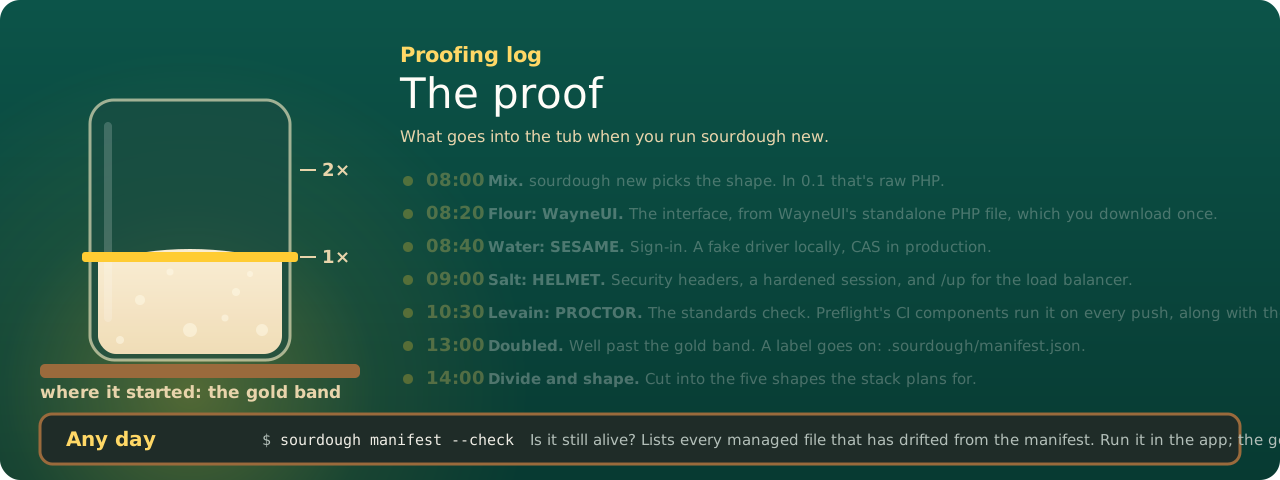
The proofing log from the front page: what goes into the tub when you run sourdough new, and the day-to-day check that keeps it alive.
What lands in every app#
Every generated app has SESAME, HELMET, PROCTOR as a dev dependency, a .gitlab-ci.yml that includes the Preflight components, a /up route that does not touch the database, and a README that points at the CREED handbook. The libraries are tagged (SESAME, HELMET with a health check, PROCTOR, Preflight templates), and sourdough new wires them into every generated app.
Defaults decide what most apps end up doing, so the stack is wired in by default, not as an option. Laravel's own kits include sign-in, rate limiting and two-factor login out of the box for the same reason.
For the Playbook and ADVISOR wiring and the flags that turn each one off, see Commands.
The release script runs the check, but do not call it the gate#
The Citadel release script asks PROCTOR's deploy gate (proctor gate, from Squire's kit 0.9.0 and PROCTOR 0.8, graded on the PHP that runs the release) for a go or no-go, ratcheted against the last release that went on, so a failure that is already live is held and only a new one blocks. By default it only reports a no-go; SQUIRE_PROCTOR=enforce stops the release on one, before the frontend build and the migrations. Treat it as a report either way. The kit adds two more report-only moves: after the optimize step the script restarts Laravel's long-lived processes (php artisan reload, or queue:restart and schedule:interrupt on an older Laravel; SQUIRE_ARTISAN_RESTART=0 turns it off), and the image drops shell functions from the web's PHP (SQUIRE_PHP_DISABLE_FUNCTIONS), turns on production opcache (SQUIRE_OPCACHE_VALIDATE), answers ServerTokens Prod and reads secrets from /run/secrets. Since kit 0.9.0 a Laravel release also stops before anything installs when APP_KEY is unset or APP_DEBUG is on in production (best practice 4.14). A failure in a release script cannot stop bad code from going live on a Quick Update, so the real gates are CI before merge and, later, a platform check.
Keep the start-up path small and boring#
Generated commands should run and exit on their own, with no prompts and no network calls after install. Developers, CI and coding agents all run them, and a prompt that waits for input breaks all three.
Accessibility gate#
The US Justice Department's Title II web rule sets WCAG 2.1 Level AA for state and local government web content. An interim final rule published on 2026-04-20 moved the first compliance date to 2027-04-26 for entities of 50,000 people or more and to 2028-04-26 for smaller ones. The standard and the ongoing duty to keep content accessible did not change. Whether and when the rule applies to a given WSU app is not decided here; ask WSU's accessibility office.
What Sourdough ships: every shape's pipeline renders the app's own pages and checks them with Preflight's a11y component at WCAG 2.2 AA (which includes 2.1 AA), blocking. The Laravel shapes check the home page signed out and the dashboard signed in through /login; the raw shapes check their one page, signed in by SESAME's fake driver, and raw + Vue saves /api/me so its Vue app draws the signed-in view. In production the sign-in page itself is the CAS server's. WayneUI's accessible templates are the default markup, and Sourdough's own pipeline runs the same component over every page under site/, so the "new app" page passes the gate when it lands there. How the pages are saved is in CI.
Protect deploy credentials in the generated pipeline#
GitLab's docs say masking a variable does not reliably stop a malicious user from reading it; protected variables exist only in pipelines on protected branches and tags; a pipeline for a merge request from a fork should run in the parent project only after review, because malicious code can compromise masked and protected variables; and sensitive values belong in an external secrets manager. A project's job-token allowlist includes only the project itself by default, and GitLab calls disabling it a security risk. From GitLab 19.0 job tokens use the JWT format by default, and the legacy format is available only until 20.0.
What Sourdough ships: Citadel deploys by Quick Update, so a generated pipeline holds no credential and runs no deploy job. Each shape carries a .deploy template (no merge request pipelines, protected refs only, one deploy at a time) for the day an app adds one, Preflight's secret-detection component (Gitleaks) fails a pipeline that commits a credential, and Sourdough's suite fails when a shape's job deploys without .deploy, a component input carries a variable other than the host and IMAGE_PREFIX, or the file sets a variable named like a credential. The settings a file cannot hold are a checklist in every generated README: protected main and tags, protected and masked variables, the job-token allowlist on with projects added by name, fork merge requests read before they run, and the deploy target's own secret store for anything long-lived. Details in CI.
Where the code lives#
The canonical repository is enterprise-apps/sourdough on git.wayne.edu. Open issues and merge requests there; tags are made there, by the maintainer, with an approver. GitHub (waynestate/sourdough) is a read-only push mirror of it: nobody pushes to it, and Packagist reads from it. git.wayne.edu is the starter culture now; GitHub is the slice Packagist eats.